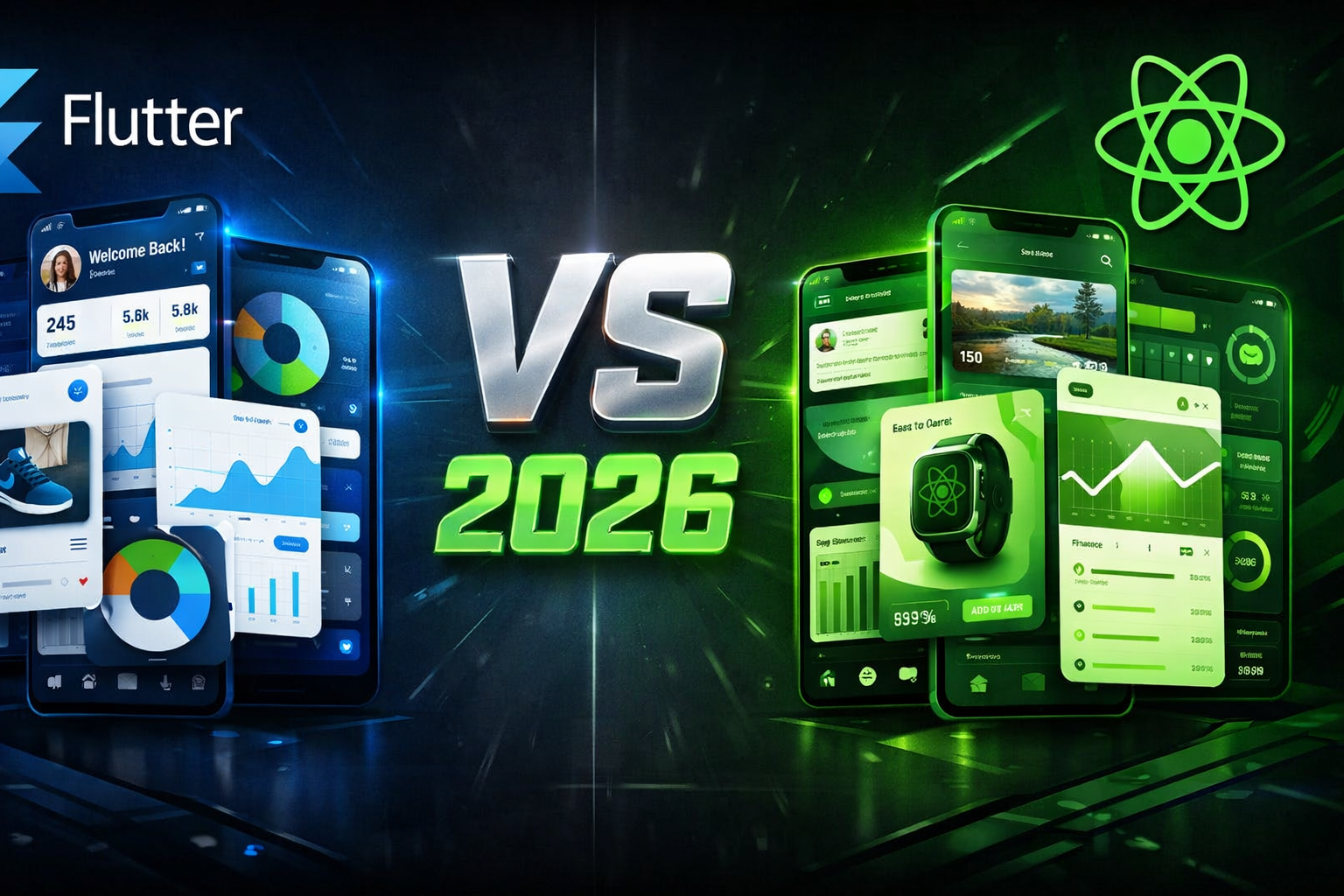
The Battle That Every Developer Faces in 2026
If you have ever sat down to plan a mobile app and asked yourself — Flutter or React Native? — you are not alone. In 2026, this is still one of the most searched questions in the mobile development world, and the answer is not as straightforward as a simple yes or no.
Both frameworks are mature, battle-tested, and backed by tech giants. Flutter comes from Google. React Native is Meta’s baby. Both let you write one codebase and ship to iOS and Android simultaneously. Yet they are fundamentally different in how they work, what they look like, and what kind of teams should use them.
At VirtueNetz, we build mobile apps every single day. We have worked with startups launching their first product, and with established businesses scaling their platforms. And we have used both Flutter and React Native in real projects. So this comparison is not theoretical — it is practical, honest, and up to date for 2026.
Let’s break it all down.
Quick Overview: Flutter and React Native at a Glance
Flutter was launched by Google in 2018 and has grown explosively since then. It uses the Dart programming language and its own rendering engine (Impeller in 2026) to draw every pixel on screen itself — without relying on native components.
React Native was launched by Meta (formerly Facebook) in 2015 and was one of the first serious cross-platform frameworks. It uses JavaScript or TypeScript and bridges your code to native UI components on each platform.
Both are open-source, both are free, and both can produce apps that look and feel professional. The real differences show up when you dig deeper.
Flutter vs React Native 2026 — Feature Comparison Table
Here is a side-by-side comparison to give you a high-level view before we go deeper:
| Feature | Flutter | React Native | Winner 2026 |
| Language | Dart | JavaScript / TypeScript | React Native |
| Performance | ⭐⭐⭐⭐⭐ | ⭐⭐⭐⭐ | Flutter |
| UI Consistency | Custom Widgets | Native Components | Flutter |
| Community | Growing Fast | Very Large | React Native |
| Learning Curve | Medium | Easy for JS devs | React Native |
| Hot Reload | ✅ Yes | ✅ Yes | Tie |
| Web & Desktop | ✅ Full Support | ⚠️ Partial | Flutter |
| Backed By | Meta | Tie |
1. Performance: Which One is Actually Faster?
Performance is usually the first concern for any app project, and for good reason. A slow app loses users fast.
Flutter Performance in 2026
Flutter uses its own rendering engine called Impeller, which replaced the older Skia engine. Impeller pre-compiles shaders, which means no more jank on first frame renders. In 2026, Flutter apps consistently deliver 60fps and even 120fps on supported devices.
Because Flutter does not rely on a JavaScript bridge, there is no communication overhead between your logic and your UI. Everything runs on the same thread pipeline.
React Native Performance in 2026
React Native introduced the New Architecture — including JSI (JavaScript Interface) and the Fabric renderer — which significantly improved its performance. The old bridge is gone. Direct JavaScript-to-native communication is now much faster.
For most standard apps — e-commerce, social media, utility apps — React Native performs excellently in 2026. You will not feel a meaningful difference in everyday use.
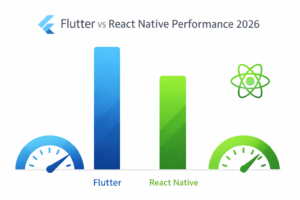
Verdict: Flutter wins in raw performance benchmarks. But React Native with New Architecture is no longer slow. For high-graphic apps or games, choose Flutter. For typical business apps, either works.
2. UI and User Experience: How Do the Apps Look?
Flutter UI
Flutter has its own library of widgets. Every button, text field, and card is drawn by Flutter itself — not by the operating system. This means your app looks exactly the same on iOS and Android.
The Material 3 design system is fully supported, and Flutter’s widget catalog in 2026 is massive. You can build virtually any UI you can imagine.
React Native UI
React Native uses native components. On iOS, it uses UIKit. On Android, it uses the Android View system. This means your app will look and feel more native to the platform — iOS users get iOS-style buttons, Android users get Android-style buttons.
For apps where platform consistency matters — especially enterprise apps — this native feel can be a significant advantage.
Verdict: Flutter for pixel-perfect custom designs. React Native for apps that should feel native to each OS.
3. Ecosystem, Libraries & Community Support
No developer builds everything from scratch. The package ecosystem matters enormously.
Flutter Ecosystem
pub.dev (Flutter’s package repository) now has over 40,000 packages as of 2026. Google actively maintains core packages. The community has grown to millions of developers worldwide, and documentation quality is exceptional.
React Native Ecosystem
npm and the JavaScript ecosystem are the world’s largest. React Native benefits from the entire JavaScript community — thousands of packages, countless tutorials, Stack Overflow answers, and YouTube courses. If you get stuck, someone has already solved your problem.
Verdict: React Native wins on ecosystem size. Flutter wins on quality and consistency of official packages.
4. Learning Curve: Which Is Easier to Learn?
If your team already knows JavaScript or React, React Native is a very natural transition. You are using the same paradigms — components, props, state, hooks.
Flutter requires learning Dart, which is a relatively new language. However, Dart is clean, well-structured, and beginner-friendly. Most developers with any programming background pick it up within a few weeks.
Verdict: React Native is easier if your team knows JavaScript. Flutter has a steeper curve but Dart is genuinely enjoyable to write.
5. Jobs and Demand in 2026: Which Has Better Career Prospects?
Both frameworks are in high demand in 2026. However, the market has shifted noticeably.
- Flutter job listings on LinkedIn and Indeed have grown by over 60% since 2023.
- React Native remains dominant in US and European markets.
- In South Asia — including Pakistan, India, and Bangladesh — Flutter demand has surged dramatically.
- Google continues to invest heavily in Flutter, adding web, desktop, and embedded device support.
Verdict: React Native has more jobs globally right now. Flutter is growing faster and has strong prospects for 2026 and beyond.
6. When Should You Choose Flutter?
Choose Flutter if:
- You need a visually rich, custom UI that looks identical on all platforms.
- Your app will target iOS, Android, Web, and Desktop from one codebase.
- Performance is a top priority — animations, games, data-heavy dashboards.
- You are starting fresh and your team is open to learning Dart.
- You want a rapidly growing framework with strong Google backing.
7. When Should You Choose React Native?
Choose React Native if:
- Your team is already experienced in JavaScript or React.
- You need a large number of third-party integrations and packages.
- Your app needs to feel native on each platform (iOS vs Android).
- You are building a startup MVP quickly with a JS-heavy team.
- You need mature enterprise-level tooling and community support.

Why Pakistani Businesses Choose VirtueNetz for Mobile App Development
At VirtueNetz, we don’t just write code — we build products that solve real business problems. Whether you need a Flutter app with stunning animations or a React Native app deeply integrated with your existing JavaScript backend, we have the team and the experience to deliver.
We have helped businesses across Pakistan, the UK, the US, and the Middle East build mobile apps that their users love. From fintech and e-commerce to healthcare and logistics, our apps have processed millions of transactions and served thousands of daily users.
Our Mobile App Development Services Include:
- Custom Flutter App Development for iOS, Android, Web & Desktop
- React Native App Development with New Architecture
- UI/UX Design for Mobile Applications
- App Performance Optimization & Code Audits
- Migration from React Native to Flutter (and vice versa)
- Post-launch Maintenance, Support & App Store Submission
| Not Sure Which Framework Is Right for You? Our experts at VirtueNetz will analyze your project, your team, and your goals — and give you a free, honest recommendation. No sales pitch. Just real advice. |
Conclusion: Flutter vs React Native 2026 — The Real Winner
Here is the honest truth: there is no single winner. Both Flutter and React Native are excellent frameworks in 2026. The best choice depends entirely on your specific situation.
If you want blazing performance, beautiful custom UIs, and a framework growing at rocket speed, Flutter is your pick. If you want the comfort of JavaScript, the largest ecosystem, and native platform feel, React Native is your pick.
What matters most is not which framework you choose — it is who builds your app. A great team with the right framework will always outperform a mediocre team with the “perfect” framework.
At VirtueNetz, we are experts in both. We match the right tool to your project, and we deliver apps that work, scale, and grow with your business.
🌐 Visit VirtueNetz — Pakistan’s Top Mobile App Development Company
FAQs — Flutter vs React Native 2026
Q1. Is Flutter better than React Native in 2026?
Flutter leads in performance and UI consistency. React Native leads in ecosystem size and developer availability. Neither is universally better — it depends on your project requirements.
Q2. Which is faster: Flutter or React Native?
Flutter is generally faster due to its own rendering engine (Impeller). React Native’s New Architecture has closed the gap significantly, making both suitable for most production apps.
Q3. Which framework is easier to learn in 2026?
React Native is easier if you already know JavaScript or React. Flutter requires learning Dart, but Dart is a clean, modern language that most developers pick up quickly.
Q4. Does Google still support Flutter in 2026?
Yes. Google actively funds and develops Flutter. The framework supports iOS, Android, Web, Desktop, and even embedded systems in 2026.
Q5. Can VirtueNetz build apps in both Flutter and React Native?
Absolutely. VirtueNetz has experienced developers for both frameworks. We will recommend the best fit for your project and deliver high-quality, production-ready applications.