
You have probably heard the term ‘AI agent’ and wondered what it actually means and whether it is just a fancy word for chatbot. It is not. This guide explains what AI agents are, how they are different from the AI tools you already know, and what kinds of business problems they are uniquely good at solving.
What Is AI Agent Development? The Plain-Language Explanation
An AI agent is a software system that can take a goal — not just a question — and figure out how to achieve it. It plans the steps, uses whatever tools it has access to, checks its own work, and keeps going until the goal is achieved or it determines it cannot proceed.
Here is a simple example of the difference:
| 💬 Chatbot vs AI Agent — The Same Scenario Chatbot: Customer types “I want to change my delivery address.” Bot says “Please contact our support team.” End of conversation. AI Agent: Customer types “I want to change my delivery address.” Agent checks the order status (is it already shipped?), verifies the customer’s identity, accesses the order management system, updates the address if the order has not shipped, sends a confirmation email, and logs the change in the CRM. All automatically, without a human involved. |
The chatbot answers. The AI agent acts.
That distinction — between answering and acting — is the core of what makes AI agents different, and why they can solve a much broader range of business problems than a conventional chatbot.
How AI Agents Actually Work — Without the Technical Jargon
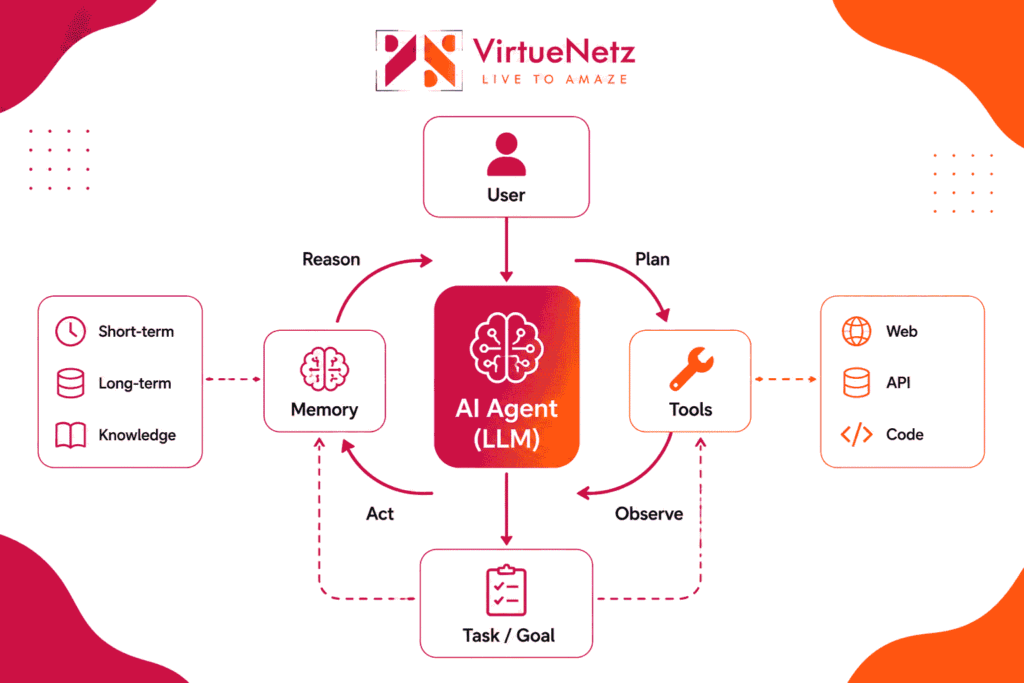
An AI agent is built on a large language model (LLM) like GPT-4o or Claude — the same technology that powers AI chatbots. What makes it an agent rather than a chatbot is the additional architecture around that model:What Is AI Agent Development
1. A Goal, Not Just a Prompt
A chatbot responds to one message at a time. An AI agent receives a goal — ‘qualify this lead and add them to the CRM’ — and then figures out the sequence of steps needed to complete it. It can plan, prioritise, and adapt if a step fails.
2. Tools It Can Use
Agents are given access to tools — APIs, databases, search engines, email systems, calendars, browsers, code executors. When the agent decides it needs to check inventory, it calls the inventory API. When it needs to send an email, it uses the email tool. The tools are its hands; the LLM is its brain.
3. Memory
AI agents can remember context across a long task — what steps have been completed, what the results were, what is still needed. This short-term working memory is what allows them to execute complex multi-step processes without losing track of where they are.
4. Self-Checking
Good AI agent architectures include a feedback loop — the agent checks whether its action achieved the expected result before moving to the next step. If something went wrong, it tries a different approach rather than blindly proceeding.
| ℹ️ The Technical Term You Will See AI agents are often described as ‘ReAct’ systems (Reason + Act) or ‘agentic workflows’. Frameworks like LangChain and LlamaIndex provide the infrastructure for building them. You do not need to understand these details to commission an AI agent — but knowing the vocabulary helps you have better conversations with developers. |
AI Agent vs Chatbot — What Is the Actual Difference?
The distinction matters practically because it determines what kind of problems each is suited to. Here is a direct comparison:
| Traditional Chatbot | AI Agent |
| Follows a fixed script or decision tree | Plans its own steps based on the goal |
| Answers one question at a time | Executes multi-step tasks autonomously |
| Tells you it cannot do something | Tries different approaches to solve the problem |
| Connected to one or two data sources | Orchestrates multiple tools, APIs, and databases |
| Static — same behaviour until manually updated | Learns from outcomes and improves over time |
| Best for FAQs and simple query routing | Best for complex, multi-system workflows |
The practical implication: if you need to answer customer questions — use a chatbot. If you need to automate a workflow that involves multiple systems and multiple steps — you need an AI agent.
Our AI chatbot development service covers the chatbot use case in depth. If your needs go beyond question-answering into workflow execution, you are looking at an AI agent — covered by our custom AI development services.
What AI Agents Actually Look Like in Business
Abstract explanations only go so far. Here are concrete examples of AI agents in business contexts — the kinds of things we build at VirtueNetz:
Example 1: Lead Processing Agent
A new lead fills out a contact form on your website. An AI agent:
- Reads the form submission and extracts name, company, budget, and service interest
- Searches LinkedIn for the company profile and assesses company size and industry
- Scores the lead based on your qualification criteria
- Creates a contact and deal in your CRM with all relevant data
- Sends a personalised first email acknowledging the enquiry
- Assigns the lead to the correct sales representative based on service type and geography
- Creates a follow-up task in your project management tool for 48 hours later
All of this happens within 90 seconds of form submission — without a human touching it.
Example 2: Customer Complaint Resolution Agent
A customer emails your support address with a complaint about a delayed order. An AI agent:
- Reads and categorises the complaint (delivery delay, not damaged or fraud)
- Looks up the order in your ecommerce system and retrieves tracking information
- Checks whether the delay is within your SLA or outside it
- Drafts and sends an appropriate apology email — referencing the specific order and reason for delay
- If the delay exceeds SLA, automatically generates and sends a discount code
- Logs the complaint, resolution, and compensation in your CRM
- Escalates to a human agent only if the customer responds with further dissatisfaction
| ✅ The Impact An AI agent handling 80% of complaint resolutions autonomously can reduce your customer service team’s workload dramatically while improving resolution speed and consistency. |
Example 3: Content Research and Briefing Agent
A marketing team asks an AI agent to research and produce a content brief for a new blog post topic. The agent:
- Searches Google for the top 10 ranking pages on the topic
- Reads and summarises the key points, headings, and angles covered
- Identifies gaps and angles not covered by existing content
- Checks your brand guidelines and past content for tone alignment
- Produces a structured content brief with recommended H2s, key points, target keywords, and suggested word count
- Delivers the brief into your project management system and notifies the assigned writer
A task that previously took a content strategist 2–3 hours now takes the agent 8 minutes.
Types of AI Agents — Choosing the Right Architecture
Not all AI agents work the same way. The architecture you choose affects capability, cost, and reliability:
| Agent Type | How It Works / Best Use Case |
| Single-Task Agent | One focused goal, one set of tools. Most common for business automation. Example: a lead qualification agent. |
| Multi-Agent System | Multiple specialised agents working together. One orchestrates, others execute. Best for complex workflows spanning multiple domains. |
| RAG Agent | Combines retrieval from a knowledge base with reasoning. Best for customer-facing AI that needs to answer questions accurately from your data. |
| Tool-Use Agent | Can browse the web, execute code, read files. Best for research, data analysis, and content tasks. |
| Conversational Agent | Maintains long conversation context while executing tasks. Best for support and sales contexts where natural dialogue is important. |
When Does Your Business Actually Need an AI Agent?
AI agents are powerful but not always the right tool. Here is a practical framework for deciding:
Use an AI Agent When:
- The task involves more than 3 steps and requires using multiple systems
- The task is high-volume and consistent enough to justify automation
- Human errors in the current process are costly or create downstream problems
- Speed of execution matters — the task needs to happen in seconds, not hours
- You want to free up skilled human time for work that requires judgment
Do Not Use an AI Agent When:
- The task genuinely requires human empathy, creativity, or ethical judgment
- The volume is too low to justify the build cost — a manual process works fine
- Your data quality is too poor to support reliable AI reasoning
- The stakes of a wrong decision are catastrophically high with no human review step
| 🎯 The Right Starting Point Start with one well-defined, high-volume workflow that currently takes significant human time. Map every step of that workflow clearly. Then ask: could an AI system follow these steps reliably, given access to the right tools and data? If yes, you have your first AI agent project. |
How VirtueNetz Builds AI Agent Systems
Our AI agent development process follows the same structured approach as all our custom AI development work — discovery, architecture design, development, testing, and ongoing support. A few aspects are specific to agents:
- Workflow mapping before architecture — we map every step of the current process before designing the agent system
- Tool inventory — we audit every system the agent needs to access and design secure, reliable integrations
- Human-in-the-loop design — we decide upfront which decisions require human review and build escalation paths accordingly
- Failure mode engineering — we design explicitly for what happens when a tool is unavailable, data is missing, or the agent gets confused
- Monitoring and observability — every agent action is logged, traceable, and reviewable
For businesses needing AI agent development as part of an offshore engagement, our offshore AI development service covers how we work with US, UK, and UAE clients on exactly these kinds of projects.
Frequently Asked Questions About AI Agent Development
| ❓ Is an AI agent the same as a chatbot? |
| ✅ No. A chatbot responds to questions — it is conversational. An AI agent pursues goals — it takes actions. A chatbot tells you that your package is delayed. An AI agent investigates the delay, contacts the courier, updates your order status, and sends you an apology email. The underlying technology overlaps (both use LLMs), but the architecture and capability are fundamentally different. |
| ❓ Do AI agents make mistakes? |
| ✅ Yes — and any vendor who tells you otherwise is lying. AI agents can misinterpret instructions, call the wrong tool, or take an incorrect action. Good agent architecture minimises these failures through confidence thresholds, human review checkpoints for high-stakes decisions, full audit logging, and rollback capabilities. The goal is reliable performance in the 90%+ of standard cases, with graceful human escalation for exceptions. |
| ❓ How is AI agent development different from RPA (Robotic Process Automation)? |
| ✅ RPA follows rigid scripts — if the screen layout changes or an unexpected input appears, it breaks. AI agents reason about what they are seeing and adapt. An AI agent can handle variations, edge cases, and unstructured data that would break an RPA system. For well-structured, repetitive processes on stable systems, RPA can still be cost-effective. For anything involving natural language, variation, or judgment calls, AI agents are more capable. |
| ❓ How long does it take to build an AI agent for my business? |
| ✅ A focused, single-task AI agent for a well-defined workflow typically takes 4–8 weeks. Multi-agent systems for complex workflows take 3–6 months. The largest variable is the quality and accessibility of your existing data and the complexity of the integrations required. |
| ❓ Can I start with a chatbot and upgrade to an agent later? |
| ✅ Yes — and this is often the sensible approach. Start with a chatbot that handles customer queries (quicker to build, faster ROI). Once you see the value, identify the workflows that need active execution rather than just answering — and build agents for those. VirtueNetz designs systems with this evolution in mind. |
Explore VirtueNetz’s Full AI Services Cluster
This blog post is part of our AI topic cluster. Every page below covers a related service or topic:
🏛️ AI Service Pages
| 🏛️ Custom AI Development Full overview — all AI services VirtueNetz offers in one place → View Pillar Page | 💬 AI Chatbot Development Intelligent chatbots for websites, WhatsApp, and apps → View Service | ⚙️ AI Automation for SMB Workflow automation that saves 10–40 hours a week → View Service |
| 🌐 Offshore AI Development Dedicated AI teams for US, UK and UAE clients → View Service | 👨💻 Hire AI Developers Pakistan Complete guide to finding and vetting AI talent → Read Guide |
🔧 Related Services
| 💻 Web Development Web platforms that host and front AI agent systems → View Service | 📱 Mobile App Development AI-powered apps with agent capabilities built in → View Service | 👥 Staff Augmentation Dedicated AI engineers embedded in your team → View Service |
| Ready to Build an AI Agent for Your Business? VirtueNetz designs and builds AI agent systems for businesses in Pakistan and internationally. Start with a free conversation, we will tell you honestly whether an AI agent is the right solution for your situation. → Free Consultation: virtuenetz.pk/contact-us |