
Most businesses start email marketing with a lot of confidence. They build a list, choose a platform, write a few campaigns, hit send and then nothing happens. Emails land in spam. People unsubscribe. Open rates are barely in the double digits. And sales from email? Close to zero.
If any of that sounds familiar, you are not alone. Email marketing challenges are common, and they stop a lot of businesses from tapping into what is genuinely one of the highest-returning digital channels available. Studies by Litmus consistently show that email delivers an average ROI of 36 dollars for every dollar spent higher than paid search, social media ads, or almost any other channel. But that return only comes when email is done properly.
In this article, we are going to walk through the five most common email marketing challenges businesses face and give you practical, proven ways to fix each one. If you would rather hand this over to experts and focus on running your business, our digital marketing services team at VirtueNetz is ready to help.
Why Email Marketing Still Delivers and Why So Many Businesses Struggle
Email is not a new channel and it is not a dying one either. It is personal, direct, and owned meaning you are not at the mercy of an algorithm changing the rules on you overnight the way social platforms do. When someone gives you their email address, they are inviting you into their inbox. That is a privilege, and the businesses that treat it as one tend to get exceptional results from it.
The reason businesses struggle has less to do with email as a channel and more to do with how they approach it. Sending a monthly newsletter with no strategy, no segmentation, and no clear goal is not email marketing it is just emailing. According to HubSpot’s marketing statistics, businesses that use email segmentation see a 760 percent increase in revenue compared to one-size-fits-all campaigns. That kind of difference does not come from trying harder it comes from having the right strategy.
We see this regularly with clients who come to us after their previous attempts at email marketing left them frustrated. Whether we are building a new website or running full digital campaigns, email strategy is always part of the conversation because it should be part of every business’s growth plan.
Email Marketing Challenge #1 Low Open Rates
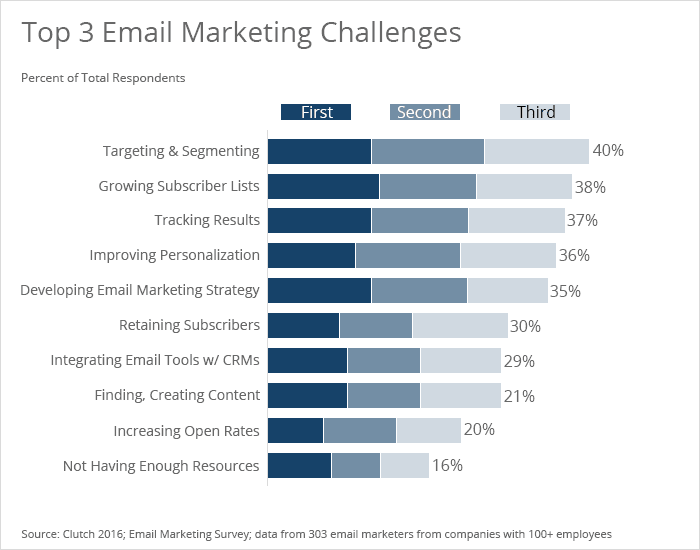
Low open rates are the first warning sign most businesses notice when email marketing is underperforming. And if people are not opening your emails, nothing else matters your offers, your content, your links none of it gets seen.
The industry average open rate sits between 20 and 25 percent depending on your sector, according to data from Campaign Monitor’s benchmarks. If your open rate is consistently below that, there is something specific causing it and it is almost always one of four things.
The Subject Line Is Your One Chance
Your subject line is the single most important element of any email you send. It is the difference between someone opening your email and someone deleting it without a second thought. A strong subject line is specific, relevant to that reader, and gives them a reason to want to know more. Generic subject lines things like ‘April Newsletter’ or ‘Exciting news from our team’ tell the reader nothing worth knowing and get ignored.
The best subject lines either promise something specific (‘How we helped a Lahore retailer increase sales by 40% with one email’), address a problem the reader has right now (‘Still not getting leads from your website?’), or create genuine curiosity without resorting to clickbait. Test different approaches with your audience and pay attention to what your open rate tells you.
Your Sender Name and Send Timing Both Matter
People open emails from people and brands they recognise. Sending from a generic ‘no-reply@yourdomain.com’ or a company name that your subscribers barely remember signing up for is a guaranteed way to reduce open rates. Use a real name either a person’s name or your brand name and make sure your subscribers have enough positive history with you to recognise it.
Timing is another factor that gets overlooked. B2B audiences generally respond better to Tuesday and Wednesday morning sends. Consumer-facing businesses often see stronger results in evenings or on weekends. The best way to find what works for your specific audience is to test it systematically. Our digital marketing team runs structured A/B tests for clients to take the guesswork out of this completely.
List Hygiene Makes a Bigger Difference Than Most People Expect
A list full of contacts who have not opened an email in six months is not just an engagement problem it is actively dragging your open rate down and damaging your sender reputation. Email providers track engagement signals, and if a large portion of your list is ignoring your emails, providers start filtering your future emails more aggressively. Clean your list regularly. Run a re-engagement campaign for inactive subscribers, and remove the ones who do not respond.
Email Marketing Challenge #2 Poor Segmentation and Personalisation

Sending the same email to every person on your list is one of the most common email marketing mistakes and one of the most damaging. Your subscribers came to you at different stages of their buying journey, they have different needs, and they are interested in different things. Treating them all identically means most of your emails feel irrelevant to most of your readers.
Segmentation solves this by dividing your list into smaller groups based on shared characteristics, then sending each group content that speaks directly to them. According to Mailchimp’s segmentation research, segmented campaigns achieve 14 percent higher open rates and 101 percent more clicks than non-segmented ones. The businesses getting those numbers are not doing anything exotic they are simply sending the right message to the right person.
Practical Ways to Segment Your Email List
You do not need a huge list or a complex CRM to start segmenting. Even with a few hundred subscribers, you can create meaningful segments that immediately improve results. The simplest and most effective place to start is behaviour separate new subscribers who need an introduction to your business from existing customers who already know you and are ready for a different kind of conversation.
Beyond that, you can segment by what someone expressed interest in (which page they visited, which lead magnet they downloaded), by where they are in the buying process, by industry or location, or by engagement level. Someone who has opened your last eight emails and clicked through three times deserves a different email than someone who has not engaged in three months.
This is one of the areas where working with a professional digital marketing agency in Pakistan pays for itself quickly. Setting up the right automation rules, data flows, and segmentation logic from the beginning saves you months of trial and error.
Email Marketing Challenge #3 Building a Quality Email List
There is a significant difference between a large email list and a good email list. A lot of businesses get obsessed with subscriber counts and end up with thousands of contacts who are not remotely interested in what they sell. This creates all the problems we have already discussed low engagement, poor open rates, and campaigns that feel like they are firing into empty space.
A quality email list is built around people who genuinely want to hear from you. They opted in because your offer was relevant to them, they find value in your emails, and when they are ready to buy, you are the first name that comes to mind. This kind of list is smaller to start with but converts at dramatically higher rates.
Give People a Real Reason to Subscribe
The days of ‘sign up for our newsletter’ getting results are mostly over. People are protective of their inboxes and they need to see clear value before handing over their email address. A strong lead magnet a free guide, a useful template, an exclusive discount, a free audit of their website or marketing gives people a tangible reason to opt in.
Your opt-in forms need to be visible and easy to complete. A sign-up form buried in your website footer is not going to build your list. Combine a well-designed opt-in on your homepage, within your blog content, and on a dedicated landing page built specifically for conversions. We design landing pages that are built to capture leads if yours is not performing, that is worth looking at.
Use Social Media to Drive List Growth
Your social media presence is one of the most underused tools for email list building. Promoting your lead magnet to your existing followers, running targeted paid campaigns to reach new audiences, and using platform-specific features like Facebook lead ads can all accelerate list growth significantly. The goal is to bring people from a channel you rent (social media) to a channel you own (your email list).
Never Buy Email Lists Ever
This is worth being completely direct about: buying email lists causes serious harm to your marketing. Purchased contacts did not ask to hear from you, they do not know who you are, and the vast majority will either ignore your emails or mark them as spam. Under the CAN-SPAM Act and similar regulations in Pakistan and internationally, sending unsolicited commercial emails can result in significant fines. Beyond the legal risk, the damage to your sender reputation can take months to recover from and affects every email you send going forward.
Email Marketing Challenge #4 Emails Landing in Spam

You write a good email, set up the campaign, and hit send and the whole thing ends up in the spam folder where nobody ever sees it. Email deliverability is one of the most technical email marketing challenges, and it is more common than most people realise, particularly for businesses that are new to email or have not maintained their lists properly.
Your emails land in spam for reasons that are usually either technical or behavioural. On the technical side, missing email authentication is the most common culprit. SPF, DKIM, and DMARC records tell email providers that your messages are legitimate without them, providers treat your emails with suspicion and filter them accordingly. On the behavioural side, sending too frequently to unengaged contacts, having a high bounce rate, or accumulating spam complaints all damage your sender reputation over time.
Fix the Technical Foundation First
If you have not set up proper email authentication for your domain, this needs to happen before anything else. SPF (Sender Policy Framework) tells email providers which servers are allowed to send emails on your behalf. DKIM (DomainKeys Identified Mail) adds a cryptographic signature to each email that confirms it has not been altered in transit. DMARC (Domain-based Message Authentication, Reporting and Conformance) defines what should happen when an email fails these checks.
These are configuration changes made in your domain’s DNS settings, and they require technical knowledge to set up correctly. If your website is hosted by us or your domain is managed through a provider we work with, our web development team can handle this setup as part of a broader technical audit. Getting authentication right is one of the highest-impact changes you can make for deliverability.
Your Sending Behaviour Shapes Your Reputation
Email providers measure how recipients respond to your emails and use that data to decide how to treat your future campaigns. If a large percentage of your list is consistently ignoring, deleting, or marking your emails as spam, your sender reputation deteriorates and more emails get filtered. This is a self-reinforcing cycle poor relevance leads to poor engagement, which leads to worse deliverability, which leads to even worse results.
The way to break that cycle is to send emails that people actually want, to people who have genuinely opted in to receive them, at a frequency that feels appropriate rather than overwhelming. Combine that with regular list cleaning to remove inactive and bouncing contacts, and your deliverability will improve significantly over time.
Email Marketing Challenge #5 Weak Conversions and No Clear Strategy
Some businesses manage to get their emails opened and even clicked, but the clicks do not lead to sales or enquiries. This is a strategy problem more than a content problem. The individual emails might be decent, but there is no journey being created no logical progression that moves someone from interested to ready-to-buy.
Every email you send should have a single clear purpose and a single clear call to action. When you pack too many messages, too many offers, and too many links into one email, readers do not know what you want them to do and end up doing nothing. Clarity and focus drive conversions. Trying to do too much in a single email undermines both.
Map Your Email Sequence to the Buying Journey
The most effective email strategies are built around how your customers actually make decisions. A new subscriber needs to be welcomed, introduced to your business, and given reasons to trust you before you ask them to buy anything. This is what a welcome sequence does it starts the relationship before asking for anything in return.
As subscribers move through your funnel, the content shifts. Nurturing emails demonstrate your expertise, address common questions and objections, share case studies and results, and gradually move people toward a decision. This is where strong content strategy becomes essential the emails that convert best are the ones that feel like they were written specifically for the reader at exactly the right moment.
Promotional campaigns, re-engagement sequences for dormant subscribers, post-purchase follow-ups, upsell sequences, and feedback requests all have their place in a well-designed email programme. Complementing this with PPC campaigns and SEO-driven content creates a full digital marketing ecosystem where every channel supports the others. The key to making email work within that ecosystem is having a deliberate plan not sending emails randomly whenever something occurs to you.
How VirtueNetz Helps Businesses Solve Email Marketing Challenges
We have worked with businesses across Pakistan and internationally on their digital marketing, and email challenges come up in almost every conversation we have with new clients. The problems are consistent poor list quality, no segmentation, weak subject lines, technical deliverability issues, and campaigns disconnected from any real business goal.
At VirtueNetz, our approach to email marketing is built around one thing: results that actually affect your revenue. We do not hand over an email platform and leave you to figure it out. We build the strategy, set up the technical infrastructure, write the email sequences, design the templates, configure the automations, and track performance against goals that matter open rates, conversions, revenue generated, and leads created. If you want to see what this looks like for a business like yours, the best next step is a conversation with our digital marketing team.
Email marketing does not exist in isolation, either. The businesses that get the best email results are the ones whose overall digital presence is strong a well-designed, fast-loading website that converts the traffic email brings, an SEO strategy that builds organic visibility, and a social media presence that keeps the brand visible between email sends. We help clients build all of it together, as part of a coordinated strategy.
Struggling With Email Marketing? Let’s Fix It.
Talk to our digital marketing team at VirtueNetz. We will audit your current email setup and show you exactly what needs to change. No obligation just an honest conversation about what will work for your business. Get in touch today →
📞 +92 315 7884477 | ✉ support@virtuenetz.pk | 🌐 www.virtuenetz.pk
Frequently Asked Questions About Email Marketing Challenges
What are the most common email marketing challenges businesses face?
The most common email marketing challenges are low open rates, poor segmentation, weak list growth, deliverability problems (emails going to spam), and a lack of clear strategy. Each of these has specific causes and specific fixes. Businesses that address all five systematically see dramatically better results from email. Our guide above walks through each one in detail and our digital marketing services cover all of them.
Why are my emails going to spam instead of the inbox?
Emails land in spam because of either technical problems missing SPF, DKIM, and DMARC authentication records or behavioural issues like sending to unengaged contacts, having a high bounce rate, or accumulating spam complaints. Fixing your technical email authentication is the first priority, followed by regular list cleaning and ensuring you are only sending to people who genuinely want to hear from you.
How do I increase my email open rate?
Improving open rates requires work on several fronts. Write subject lines that are specific and relevant to that reader rather than generic. Send from a recognisable name. Test different send times with your audience. Clean your list of inactive contacts regularly. These four changes together can move your open rate significantly in a short period of time.
Is email marketing effective for businesses in Pakistan?
Absolutely. Email marketing works exceptionally well for businesses in Pakistan across every sector retail, real estate, education, healthcare, B2B services, and ecommerce. The key is having the right strategy and the right support. Businesses that invest in proper email setup, quality list building, and consistent content see strong, measurable results. Combined with SEO services and social media marketing, email becomes a central part of a complete, high-performing digital marketing strategy.
How long does it take to see results from email marketing?
A well-structured welcome sequence can start producing leads and conversions within the first few weeks of launch. Broader email marketing results list growth, improved open rates, and consistent revenue contribution generally take two to four months to build meaningfully. Email rewards consistency. Businesses that commit to it for six months or more typically see it become one of their highest-performing channels.
Can VirtueNetz manage our email marketing for us?
Yes. VirtueNetz provides full email marketing management as part of our digital marketing services in Pakistan. This includes email strategy, list building, segmentation, copywriting, template design, automation setup, campaign management, and performance reporting. Get in touch and we can discuss what your business needs.
Other Services That Work Alongside Email Marketing
Email marketing works best when it is part of a broader digital strategy. At VirtueNetz, we offer the full range of services that complement and amplify your email efforts. Our SEO services in Pakistan bring organic traffic to the pages that feed your email list. Our social media marketing keeps your audience engaged between email campaigns. Our PPC campaigns drive targeted traffic that converts into subscribers. And our landing page design service gives your opt-in offers a professional, high-converting home on your website. Everything we do is designed to work together not as separate services, but as a coordinated system that drives real, sustained growth for your business.